-friendly. I had entirely missed this, because
is still onscreen a fair amount (though, in Ep 3.5, not enough) . But the presence of one female on-screen does not make for female-friendly films, however positively that female is represented. And, in fact, the presence of one significant female character on-screen is a very common feature of Hollywood film-making; let's call it the Single Feisty Female Story Pattern.
Bechdel-Wallace Test
Any film passes the
Bechdel-Wallace test (1) if it contains one scene in which
- Two women
- Talk to EACH OTHER
- About something other than a man.
This is a blunt but remarkably effective tool to assess not only the importance but the role of female characters in a film. Any film, feminist or not, with
strong female characters and any interest whatever in women’s stories, personhood or lives will contain many such scenes, but the bar is deliberately set low; one such scene will do to make a film pass the test. A film can pass the Bechdel-Wallace test without being female-positive, but it cannot pass without at least two female characters with a) speaking parts and b) an agenda that isn't entirely bound up with the story-line of the male characters.
The Single Feisty Female
The appallingly small number of movies that pass the Bechdel-Wallace test is obscured, for the viewer, by the presence, in many films, of the Single Feisty Female (2). This trope is particularly egregious (and reprehensible) in children's films, but may be found anywhere. The Single Feisty Female is a female character, often ostensibly central to the film. She may have quite a few lines, and may even be the lead or ostensibly the lead character in the film. However, she will be surrounded by male characters and will have no significant interaction with females. Her story is important because it is taking place in an entirely masculine world.
Thanks to my child-rearing activities in the last decade, I am much more conversant with children's movies than I used to be, and the Single Feisty Female is all over these, when there are any female characters in the film at all (by no means guaranteed, in the children's film genre. Think of "
Up" (2009), after the first 10 minutes during which we are shown the main character's entire life with his beloved wife, ending with her death in old age, as a setup for the actual story.)
To choose a few examples: in the animated children's film
"Bolt" (2008), the title figure, a dog, works with a Single Feisty Female child star. The dog itself is male - though there is no clear reason for this choice, as it's a dog with no physical gender-distinguishing features, the film is an animated feature, and most actual Hollywood dog stars are female - and all the dog's motley team of helpful hamsters etc. are male too. The girl does have a mother, who gets a single line, when the girl is offscreen. The whole 'important' story surrounds the (male) dog and his team of (male) talking animals. In the end the dog saves his mistress.
Or take "
Meet the Robinsons" (2008), about the family that forms around a young orphan boy genius, in which we find a Single Feisty Female orphan girl genius, whose talents are however directed
entirely towards endearingly impractical ends (she is teaching frogs to sing in harmony), where the hero's genius is directed towards inventing machines that transform society and make him enormous piles of money. There is one other female character, but the two females never exchange a single line of dialogue and if I remember correctly (and no, I don't propose to rewatch the film to find out) are never on screen together. The SFF grows up to marry the hero (of course).
In
Monsters vs. Aliens (2009), the appealing 50-foot female lead heroine, Susan, saves the world and is converted to feminism on realising what a jerk her ex-fiancée is. But every other member of her motley, colourful team of monsters is male, for no obvious reason (they're animated insects and blobs, you could easily give one or two girl names, but no ...); there is almost zero interaction between females at all (aside from Susan, there barely are any female characters). The movie passes the Bechdel-Wallace test on the strength of a single line, from her mother, who says "Sweetheart, I always knew you'd grow up to - uh - save the world, or something ..."
For an adult example, consider
"Inception" (2010), in which Ariadne, a single female figure, is (we are told) a better dream architect than the lead male, is the lead male's conscience, guide, helper, etc etc - in fact, is everything but the lead character herself. But Nolan, the director, does not make films about women; in fact,
given his track record, she's lucky she didn't die. Ariadne's importance lies in her importance to the story of the men in the film, and her effect on the otherwise all-male mission. She has one short conversation with an ostensibly female character who is, however, really a projection of the subconscious of the (male) protagonist.
To take a well-known and much-loved example, consider
The Princess Bride (1987). It's well-known that the Princess Bride
does not pass the Bechdel test. (5) But we do not notice the lack of any interaction between women in the film, because we're distracted by the Single Feisty Femaleness of the title character.
As an exercise to the reader, however, recall the scene after the wedding, when Buttercup is being escorted to the honeymoon suite by the king and queen, Prince Humperdinck's parents. The queen makes a couple of remarks to the king (thus establishing that she isn't mute, something we otherwise would not know). Buttercup has a brief conversation with the old and very deaf king, thanking him for his kindness to her and telling him she's about to commit suicide. The queen is a couple of steps ahead, offscreen, during this conversation. With that scene in mind, here is your exercise:
Imagine that Buttercup's brief conversation is not with the king but with the queen. How does that change the scene? How would it change the entire film, to give Buttercup one scene, however brief, with a supportive female character?
For other egregious examples, consider the popular sub-genre of female-action-figure films:
Lara Crofts (2001);
Salt (2010);
Aeon Flux (2005). All of these have strong, in fact ass-kicking, female leads, none of whom ever talk to another female. There is, not infrequently, no other female
character in the film to talk to, though there is occasionally a
fridged female victim to jar our hero into action (as in Aeon Flux). But anyone can think of 50 Single Feisty Females without much effort; it's a very old pattern. (
His Girl Friday (1940), anyone?)
The Single Feisty Female is, in all these imaginary worlds, operating in an entirely or all-but-entirely male environment. All of the other significant characters are male - indeed, all of the characters period may be male. The writers may honestly feel that they have successfully crafted a female-positive film because there is an important, even central, female character.
However, when that female is alone, in a masculine world, and all of her significant interactions are with men, the message is really that the only interesting stories are those that take place in the world of men. (4) Women are significant when they are in masculine space, interacting with men, because stories about men are assumed without argument to be inherently interesting. A woman interacting with men becomes an honorary man - a significant and interesting character - because of, and for the duration of, that interaction.
But a woman interacting with other women is not interesting. It's not a story if it doesn't involve a man, in the same way that it's not sex if it doesn't involve a penis (6). And the Single Feisty Female trope, far from reinforcing positive female role models, reinscribes the dominant paradigm, in which only men's stories matter. (7)
Now, in a television series, with a lot more time and a lot more characters, it is easier to get away from the "Single Feisty Female" trope, because you will (possibly) have more females who can sometimes interact. But many TV series do not take advantage of this opportunity. For an analysis of webs of female interaction (or the lack of them) in a few favourite series (Buffy, Xena, Star Trek:TNG; Babylon 5; Angel in the comments) see
Gabrielleabelle's charts here, and further charts,
revised and with comparisons to networks of male interaction here. (Buffy the Vampire Slayer, one need hardly add, passes the Bechdel-Wallace test with ease in every single episode. )
Next post, True Blood and the Single Feisty Female.
----------
Notes
(1) NB the link will send you to a site with a modified version of the test which also stipulates that the female characters should have names. This is not the
original version of the test, and I don't think it's a necessary addition. It raises the bar on a test that deliberately, for its shock value, sets it low. And frankly I'd be happy to see a scene in which two unnamed women discuss ammunition, or legal loopholes, or gender stereotyping in the media, as they pass in a hallway. You won't see these scenes, though.
(2) I've looked through
TVTropes and can't find this one, but may have simply been looking in the wrong place. If anyone can find a TVTrope describing a strong, confident, central female character who is, however, entirely surrounded by male characters and never interacts meaningfully with another female character, often because there are none, please send me the link and I'll edit accordingly.
(4) Masculine space - so defined by the presence of men rather than women in it - is generally, I add parenthetically, represented as public space - outdoors, public buildings, outdoor chase and fight scenes. Domestic space is often not represented, or is represented with women in it, who quickly fall out of the story.
(5) S
ee here (bechdeltest.com) for discussion of whether or not the conversation between Buttercup and the old woman for some reason universally described as "the witch", though all she seems to be is old, poor and ill-kempt, passes the Bechdel-Wallace test. The general consensus is that it does not, because a) the conversation is about Westley and b) it is only Buttercup's dream in any event, so really a conversation she is having with herself - about a man. )
(6) I really cannot get away from that analogy here; I think that is the underlying association. A woman interacting as an equal with men has been given an honorary phallus, for the duration of the story. No phallus, no story. And while "phallus", as
post-Freudian feminist analysts have shown, does not have to = "penis", but rather is the abstract quality "ability to function as in independent adult in society", in the orthodoxy of Hollywood film-making, "phallus" still has a one-to-one correspondence with "penis", and penis-owners are therefore the only things worth representing.
(7) It was when my daughter realised this - she was around 8 - that she stopped wanting to watch children's movies, except for anything by Miyazaki, a consistent and honourable exception in his portrayal not only of significant female characters but significant interactions between them.


 Image via Wikipedia
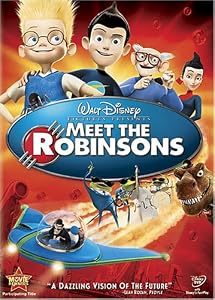 Cover of Meet the Robinsons
 Image by Brave Heart via Flickr
 Image by alfredituzz :B via Flickr

 Image by §atsukiame via Flickr

