 And now I'm lying here in my parents' house, wide awake. At least, I was until I gave up on sleep and got up.
It is a good novel. So are all Coupland's novels. And like all of Coupland's novels that I've read so far, it's very disturbing to me, because his protagonists (why are they so often compellingly middle-aged women?) are so much like me. And he asks, they ask, so many of the same questions I do, and he leaves his protagonists in exactly the state of spiritual doubt and hope I live in whenever I can't persuade myself not to think about it. And he does it so pointedly. So precisely. So painfully. So even though his protagonists do come to some accommodation at the end, he makes it clear that their accommodation with reality is,well, profoundly personal and individual. That we all have to make our own agreements and accommodations with the universe, and it's going to depend very much on who we are. Some of them come out with faith. Some don't. He never tells us who's right.
These are not exactly religious novels at all, because they don't claim to have the answer; far from it. But they are not atheist novels; they are profoundly spiritual; because his novels persistently ask the questions; does God exist? does God care about us? If there is anything more what is it? Does life mean anything at all? He doesn't give us the answers. But the questions are central to every character, sooner or later, one way or another. If Coupland believes anything, it is that an unexamined life is not worth living; even though there's no key to the examination, giving us the answers at the end.
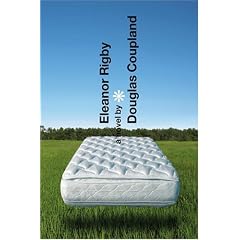
Eleanor Rigby hit me particularly hard because in this novel Coupland also deals with questions of mortality, which I worry about a lot, pointlessly, and because the central character, the narrator, Liz Dunn, is grindingly, horribly lonely. And I know about that. The feeling that there is no connection, not just between me and anyone, but between one moment and the next, there are great yawning gaps that one must somehow vault while trying not to look into the gaping void between the seconds. I haven't felt like that since I met my husband. But I remember it vividly.
But I vastly prefer Coupland to Nick Hornby, because while they ask they same sort of questions, I get the distinct impression that Hornby is fundamentally a nihilist - there really IS nothing out there, and all search for meaning is fundamentally pointless because there isn't one, period. A conclusion that would drive me back to drinking, for a start. Where Coupland seems pretty certain that it all does mean something; there is something out there, and there is a point to life while we're here; even though he, and his characters, aren't sure precisely what it is. Reading Hornby leaves me deeply depressed; so much so that I don't think I'll ever read anything of his again. Reading Coupland leaves me profoundly unsettled, because he insists on poking at questions that scare me to think about and then leaves me thinking about them. But he leaves me cautiously hopeful, too.
Still, I'm going to retire to bed with a well-worn Regency Romance, with which my mother's house is plentifully supplied, and a Janet Evanovitch novel, a vice I did not know my mother had fallen into, and hope that a half hour spent in contemplation of the loves of wealthy, upper-class, and/or extremely good-looking people will put me more in the mood for sleep. :)

